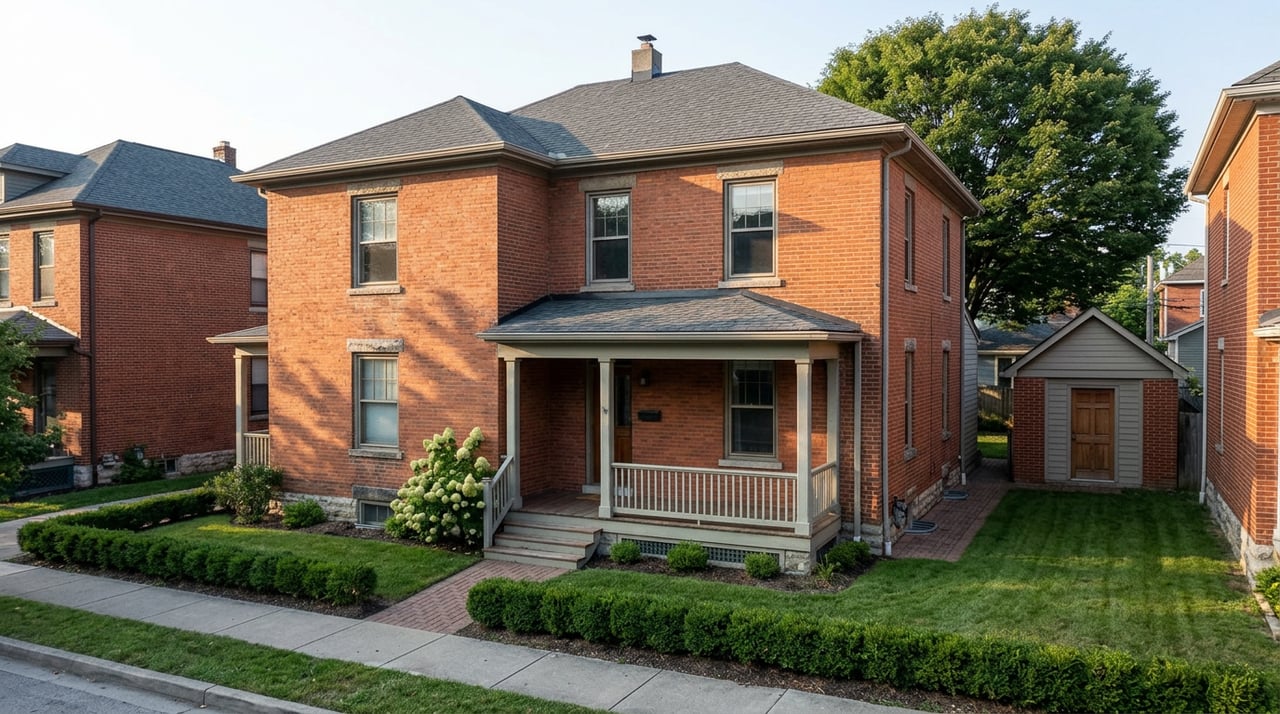
A listing for a renovated duplex on Berkeley Road went up earlier this year with a line that stopped me: the seller has "preliminary plans for a 3-car garage with a carriage house," pitched as a value-add now that the city has cleared the path for ADUs. It reads like a bonus. A buyer skimming the listing sees "ADU legislation" and mentally adds a third rent check to the spreadsheet before they've even scheduled a showing.
Here's the problem. The law that made headlines last fall changed what's allowed. It didn't change what pencils out on a specific parcel in Olde Towne East, and it didn't touch the neighborhood's actual return profile, which has run on appreciation rather than monthly cash flow for years. If you're shopping duplexes here because someone told you the ADU rule just unlocked easy income property, you need the math before you need the enthusiasm.
What actually changed in November
Columbus City Council voted on November 24, 2025 to legalize accessory dwelling units by right in every residential and apartment residential district in the city. Councilmember Otto Beatty sponsored the ordinance and called it a way for the city to finally say "yes in your backyard." Scott Messer, the city's Director of Building and Zoning Services, framed it as one piece of a larger housing push, distinct from the bigger Zone-In rezoning effort already underway across the city's commercial corridors.
Before this, adding a garage apartment or carriage house in Columbus meant applying for multiple zoning variances, a process expensive enough and slow enough that most homeowners never bothered. The new rule, which took effect December 24, 2025, removes that gauntlet for most lots. An ADU can now be an interior conversion, an attached addition, or a detached structure like a converted garage, and in most residential districts it no longer needs a hearing to get approved.
That's a genuine unlock. It's also not the whole story.
The caps nobody mentions in the listing copy
The ordinance comes with limits that shrink what "ADU income" can actually mean on a given lot:
- An ADU can't exceed 65 percent of the primary dwelling's floor area, or 1,000 square feet, whichever is greater
- Maximum height is 25 feet, or the height of the primary structure, whichever is less
- Most single-family lots get one ADU. Some R-4 districts allow two, as long as total units on the lot stay at five or fewer
- No additional off-street parking is required, which helps on Olde Towne East's tighter alley-loaded lots, but existing drive widths and utility capacity still get reviewed
- Properties inside historic or architectural review areas still need extra sign-off before a permit gets issued
That last point matters more here than in a lot of Columbus neighborhoods. Olde Towne East's housing stock is old, and the neighborhood association, OTENA, has spent decades organizing around preserving that historic character, including an annual home tour that's run since 1982. If your specific parcel falls under a design-review overlay, "by right" doesn't mean "no review." It means a different, sometimes slower review than the ADU ordinance was built to skip. Confirm this with Building and Zoning Services before you write the case for a carriage house into your offer.
What the numbers actually say about cash flow here
Set the ADU question aside for a second and look at what a duplex in Olde Towne East already earns. Recent guide data from early 2026 put the neighborhood's gross rental yield around 4.3 percent, with a price-to-rent ratio near 23x. Translation: buy at the median and rent at the median, and you're financing an appreciation play, not a cash machine. The same source is blunt about it: returns here come primarily from appreciation rather than monthly income, and the neighborhood holds tenants who choose it on purpose, which keeps vacancy low but doesn't by itself change the yield math.
Here's where it gets more specific than a single median can capture. That $310,000 figure is a neighborhood-wide median covering everything from fixer-upper singles to renovated multi-family buildings. If you're actually shopping for a duplex or triplex, the number changes. Multi-family listing data from April 2026 put the median home price for multi-family properties in Olde Towne East at $449,000, with an average sale price of $424,002 and homes spending an average of 63 days on market. A separate current snapshot of active multi-family inventory showed a median listing price closer to $470,000, with those properties sitting for a median of 102 days, nearly double the wait for single-family homes in the same neighborhood.
| Segment | Median price | Notes |
|---|---|---|
| Neighborhood-wide (all property types) | ~$310,000 | Early 2026 data, includes single-family fixer-uppers |
| Multi-family homes sold | $449,000 | April 2026, average sale $424,002, 63 days on market |
| Multi-family homes currently listed | ~$470,000 | Current inventory, median 102 days on market |
That gap between $310,000 and roughly $450,000 to $470,000 is the gap between what a generic neighborhood guide tells you and what you'll actually pay for a duplex. If you built your budget off the lower number, you're not shopping in this segment.
Does adding an ADU change the equation
Run a simple version of the math. Construction costs for an ADU in Columbus in 2026 run $150 to $400 per square foot, plus permit costs in the $10,000 to $22,000 range, with total project timelines of 4 to 10 months. A detached unit built at the maximum allowed size under the size cap, say 800 to 1,000 square feet on a lot where the primary home supports it, could run anywhere from $120,000 to $400,000 depending on finish level and site conditions, before permits.
Rents on comparable smaller units in Olde Towne East duplexes have shown up recently around $1,350 a month for a 2-bedroom unit and up to $2,250 for a larger 3-bedroom unit, based on current lease terms on actively listed properties. Even at the higher end of that range, a $150,000 to $200,000 ADU build adding $1,350 a month in rent is generating a gross yield in the 8 to 11 percent range on the incremental investment alone, well above the neighborhood's blended 4.3 percent. That's the case for building one. It's also a number that assumes you land at the low end of construction cost, get through permitting without a historic-district delay, and have a lot with the utility capacity to support a second meter.
None of that is guaranteed by the ordinance. The ordinance guarantees you won't need a variance hearing to try. It doesn't guarantee the site will cooperate, and it doesn't retroactively turn a 4.3 percent neighborhood into a double-digit cash flow market just because the paperwork got shorter.
The other thing happening on Oak Street
The ADU rule covers small-scale additions. It has nothing to do with the larger multi-unit projects already reshaping parts of the neighborhood, and those are worth knowing about if you're trying to read where the area is headed. A father-son development team has been active on Oak Street, having renovated a 15-unit apartment building at Sherman Avenue and Oak Street and completed a new-build duplex at 1219-1221 Oak St. A separate proposal for a five-story building at Oak and Wilson needed zoning variances submitted to the city and has gone through the planning and zoning committees of the Near East Area Commission, the body that reviews development here. That commission holds a general meeting the second Thursday of each month and a dedicated zoning meeting the fourth Tuesday, both open to the public, which is where these larger projects get vetted long before they ever reach City Council.
If you're buying a duplex expecting an ADU to be your only lever, that's a different conversation than the one happening at Oak and Wilson. But the commission's continued involvement in bigger projects is a reminder that the neighborhood's growth is still being negotiated parcel by parcel, meeting by meeting, not settled by one ordinance.
Before you write an ADU into your offer
- Request a Preliminary Zoning Review from Columbus Building and Zoning Services before assuming any parcel qualifies
- Ask directly whether the property sits inside a historic or architectural review overlay
- Confirm utility capacity and sewer connection points for the specific lot, since these often determine feasibility more than zoning does
- Price the ADU build against actual comparable rents in the neighborhood, not aspirational ones
- Remember that adding a fourth unit to a lot with three already on it can trigger multi-family building code classification, which carries its own requirements
A few questions I hear often
Does the new ADU rule apply to a duplex that already has two units? Yes, in most residential districts, subject to the same size and unit-count limits. A duplex adding a third unit through an ADU still needs to stay within the total unit caps for that zoning district, and the combination may shift the property into a different building code category depending on final unit count.
How long does the ADU process actually take once you're approved? Recent Columbus-specific estimates put a straightforward interior conversion on the faster end and a new detached structure at 4 to 10 months from start to finish, with weather playing a real role in construction timing.
Is Olde Towne East a good fit for someone who wants monthly cash flow, not just appreciation? Based on current yield data, this is an appreciation-first neighborhood. An ADU can improve the math on a specific property, but it takes real capital and the right lot conditions to move the needle, and it won't turn a 4.3 percent neighborhood into a high-yield one on its own.
If you're weighing a duplex here against something in a different Columbus neighborhood, or trying to figure out whether a specific Olde Towne East lot can actually support an ADU before you write the offer, I'd rather walk through the numbers with you now than have you find out mid-contract. Reach out to Sarah Moore and let's map out what a specific property in this neighborhood can actually do for you.